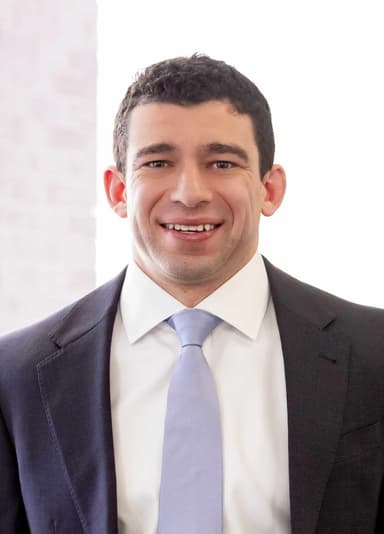
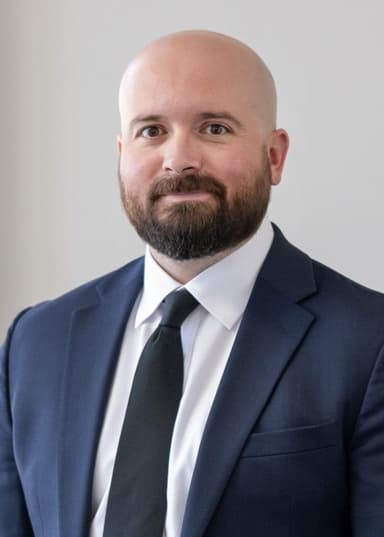
Sharif Gray · Zac Grubaugh
Charles Stuart v. Analise Presley
 June 22, 2026 ||

On the Monday after Thanksgiving in 2022, Defendant Analise Presley was driving northbound on Interstate 81 near the Blacksburg/Radford area at the end of an approximately 13-hour drive home from Bryant, Arkansas. Traveling below the speed of traffic in the left lane, she merged into Plaintiff Dr. Charles Stuart’s vehicle as he passed in the right lane — caught between her car and a fast-approaching 18-wheeler — clipping his vehicle and forcing it to rotate sharply at highway speed.
The plaintiff was a strong but complicated client: a roughly 70-year-old military veteran and 20-plus-year law enforcement officer with a long list of unrelated health conditions. The claim was deliberately narrowed to a single body part — his left shoulder — which he had never injured before. He drove all the way home to Pennsylvania, then presented to urgent care on November 30, 2022, reporting shoulder and neck pain. He was ultimately diagnosed with a full-thickness rotator cuff tear and underwent two surgeries: an arthroscopic rotator cuff repair with biceps tenodesis (Surgery #1, January 2024) and a reverse total shoulder replacement (Surgery #2, March 2025).
The nine-month treatment gap, explained. The timeline was the defense’s favorite weapon. After the November 30 urgent-care visit, the plaintiff’s documented, focused shoulder treatment did not begin in earnest until roughly September 2023. The innocent explanation — and the one the team had to teach the jury — was orthopedic triage: the plaintiff had a pre-scheduled left hip replacement (May 2023), and you cannot rehabilitate a hip on crutches or a walker if the shoulder is not yet repaired, so surgeons address the lower extremity first. The shoulder work was therefore deferred, not absent, and the very first record — two days after the collision — already documented the shoulder complaint.
Liability was admitted (“I made contact with his car. Yes.”), and the defense stipulated that contributory negligence was not in play. The trial therefore turned entirely on causation and damages. Because the medical bills (north of $150,000) dwarfed the $20,000 offer, a measure of economic damages was claimed alongside the non-economic case, and the verdict form asked for up to $10.2 million.

If you can't attend Live, Watch On Demand